AI-assisted implementation

Build a public service around your own rules.

Adapt open-source registry software to your forms, rules and review steps. Your service reads these from a set of files called its configuration. We use AI to draft the configuration and the test cases. You review, test and approve each change.

We are Aubex. We offer this as a paid service called Pilot register implementation.

Example: change drafted by Aubex

Open enrolment to five-year-olds

Entry age
6 years to 5 years
Turns five by the cut-off
Meets the age rule
Turns five after the cut-off
Does not meet the age rule

Drafted with AI. Tests pass. Waiting for the education authority’s approval.

Fictional example: a change to the school-entry age rule. The test results are waiting for the education authority’s approval.

Example: school enrolment

Change one rule across the whole service.

An education authority lowers the entry age for pre-primary school. This changes:

  • what the service checks
  • what staff tell parents
  • what the assignment notice says

We use AI to draft the changes. The education authority reviews the proposed behaviour and the test results. Then it approves the release.

What we check before release

Eligibility
The service applies the cut-off date for the correct school year.
Evidence
An approved age check uses the revised rule. It has an agreed fallback.
Notice
The assignment letter names the right programme and start date.
Guidance
The portal and the school office give parents the same information.

Each change is tested before it is released.

Keep your rules in files

The service reads its configuration from files. Your team keeps these files in version control. Version control is a system that records every change to a file. Before release, a comparison with the version in use lists each change. It also marks the changes that need review.
Run test cases on every change

Each service keeps test cases. These are requests that must be allowed and requests that must be refused. They run again on every change.

A failed check stops the release

The service refuses to start with a configuration that fails its checks. Your team approves the change after the checks pass.

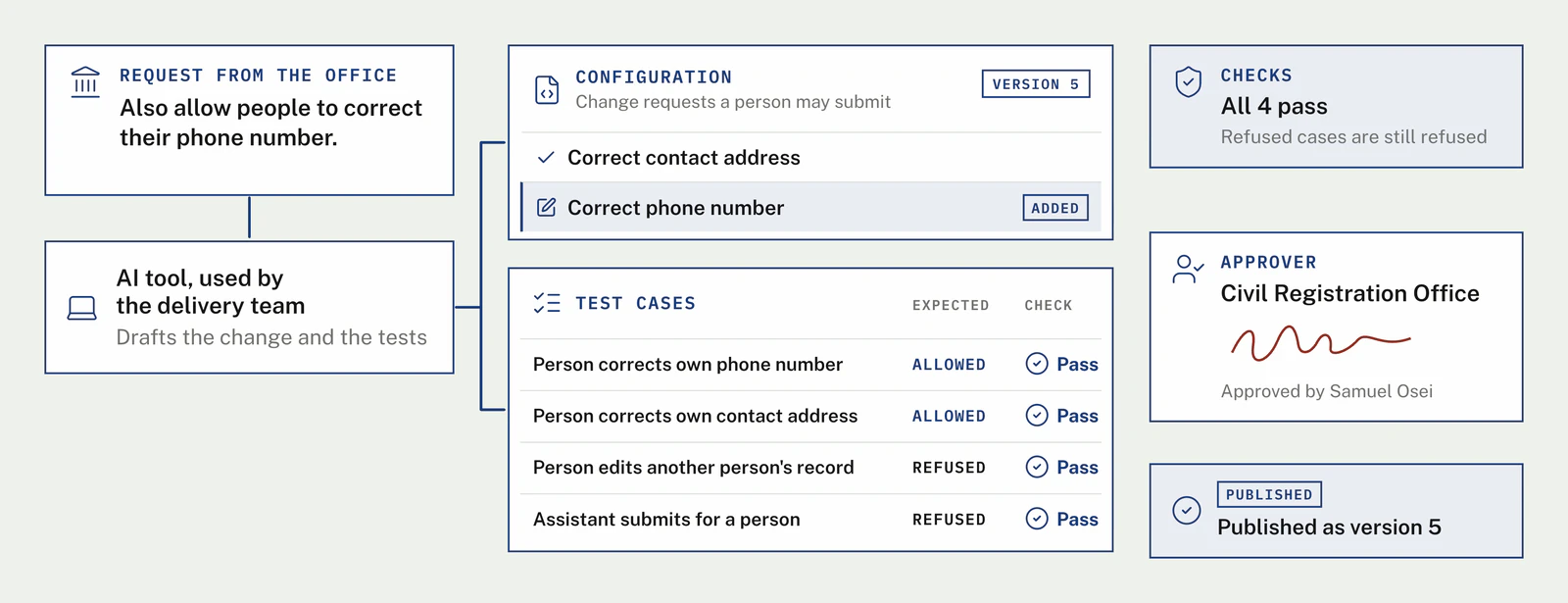
A request from the office: also allow people to correct their phone number. An AI tool used by the delivery team drafts the change and the tests. Configuration version 5 adds Correct phone number to the changes a person may submit. Four test cases: a person correcting their own phone number or contact address is allowed. A person editing another person’s record, or an assistant submitting for a person, is refused. All four checks pass. An approver at the Civil Registration Office signs, and the change is published as version 5.
A second fictional example: a civil registration office asks to let people correct their phone number. The delivery team’s AI tool drafts the change and its tests, and the office’s approver signs once all four pass. Open the full-size picture.

Technical teams can read how a configuration is checked, tested and packaged.

AI in delivery

How we use AI in your implementation.

We work from:

  • your service requirements
  • any forms you already use
  • fictional example cases

Before the implementation starts, you agree which AI tools and which data you allow. Your team reviews the proposed changes and the test results before it approves a release. Once configured, your service runs on its rules without an AI model. AI is a tool we use. It is not an autonomous product and it never decides.

To see the implementation scope and who is responsible for what, read how implementation works. If you are still defining your service, read about preparing a service brief.

Preview

Registry Studio

Registry Studio is an authoring workspace. You can use it to review records, service steps and proposed changes.

Explore Registry Studio

Scope your pilot register.

Bring your requirements or a public form, and a fictional example of what the service needs to do. We discuss with you what to build and test. Tell us which AI tools and which data your institution allows. We work within them.