Read the narration
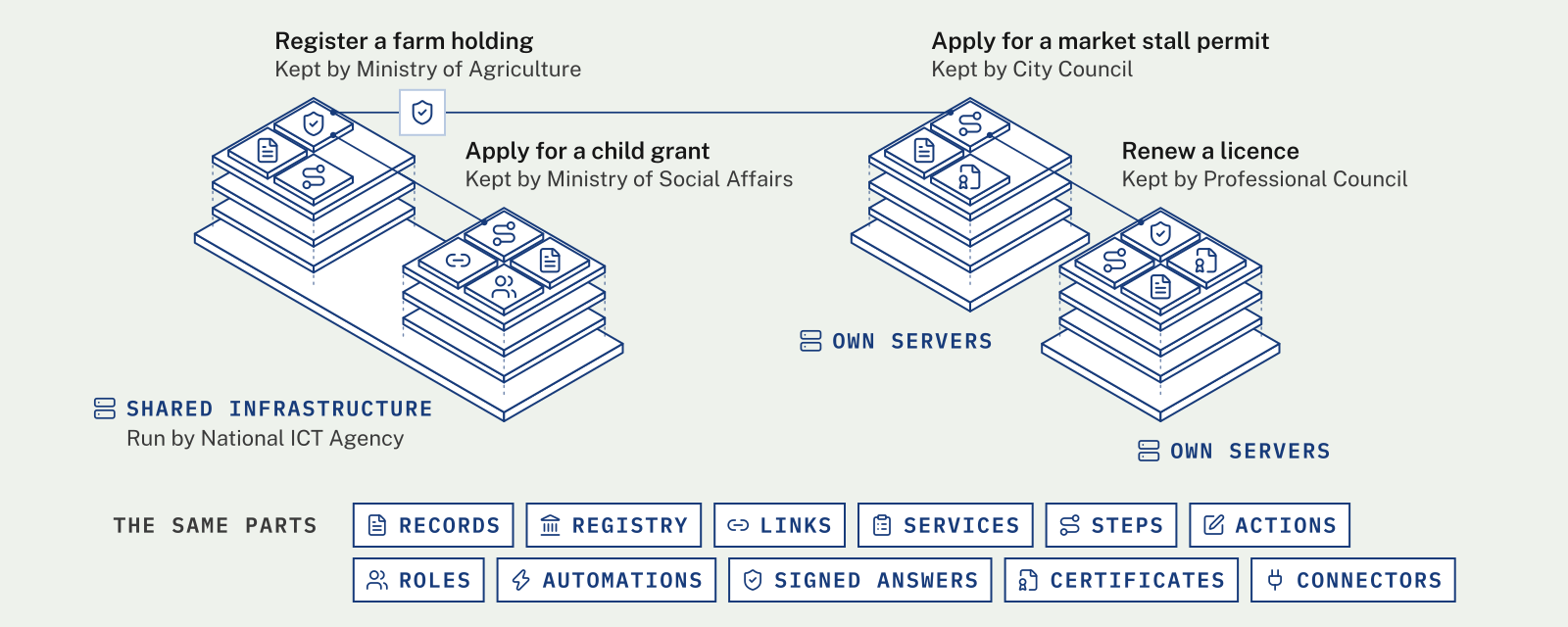
Governments run many different public services. Each one is often built from scratch. Registry Stack is open-source software that lets public authorities build them from the same few parts. Records and registries. Steps and roles. Signed answers and certificates. Each service simply uses a different mix.
They can use the same definitions, too. PublicSchema publishes them openly. Each registry copies the definitions it needs, like Person or Household, and adds its own: an enrolment, a farm holding, a birth. After that, no registry looks PublicSchema up while it runs. So a signed answer about a Person means the same thing on both sides. Separate records. The same definitions.
Now, a licence renewal. Submitted. Then a check: another authority sends a signed answer. A question goes back to the requester: waiting for you. Their reply comes in, and the request is approved. The renewal is recorded, and a notice goes out. Other services reuse the same steps.
A business registers. Its record changes, and stays where it is. A sealed certificate comes off the record. Anyone checking it gets a signed yes. Systems get an answer, not a copy. Other authorities ask too: a city council, a ministry. Each gets only a signed answer. Records stay put. Only signed answers travel.
Each authority runs its own installation: its own registries, an engine that runs the steps, sign-in, roles and an audit trail, all on its own servers. Step back: many installations, the same parts. One can keep several registries. They exchange signed answers directly, never copies. Two share government servers, but not their records.
One council’s service can become another’s template. Each council adapts it: one adds a site visit, one drops the fee. The design travels. The records never do.
Many public services, built from the same parts. Each authority keeps its own records. Registry Stack. Open source, at registrystack.org.